


Quick answer: The marketers winning right now are not specialists in one format. They combine sharp copy, confident video, and light automation into one system where each format feeds the others. I run this exact engine for the brands I manage: write it once, film it, automate its distribution, and make every idea live in three or more formats. Here is how the pieces fit together.
Why One Format Is No Longer Enough
A few years ago you could grow a brand on copy alone, or video alone. Those days are gone. Your audience discovers you on short video, evaluates you on your website copy, and stays for your emails. A brand fluent in only one format is invisible everywhere else.
I learned this the slow way. Early in my client work I wrote strong captions for accounts with no video presence, and the words had nowhere to travel. Then I filmed good videos for brands with weak profiles and bios, and the attention leaked out the moment someone tapped through. The format you skip is the hole your results fall through.
The marketers I see thriving now are multi-modal by necessity, not by trend-chasing. They do not think in posts. They think in ideas, and every idea gets expressed in the format each platform rewards. Copy for depth. Video for reach. Automation so the whole thing does not depend on memory and mood.
The Three Gears: Copy, Video, and Code
Think of it as an engine with three gears. Each one does a job the others cannot, and the engine only runs when all three turn together.
Gear one: copy is the foundation
Every video needs a script, or at least a hook written down. Every email needs words that earn the open. Every landing page needs sentences that do the selling while you sleep. Clear writing underpins everything, which is why I still consider it the highest-leverage skill in marketing. If you can write clearly, you can direct every other format.
This is also why learning to brief AI tools well starts with writing well. Telling a model what you want, with context and examples, is the same discipline as writing a creative brief. My prompt engineering playbook covers that skill in depth, and everything in it applies double when you are briefing video concepts instead of just captions.

Gear two: video is the distribution
Short video is where attention lives now. That is not an opinion, it is just where the feeds point. But notice something: the best brand videos are simply good copy performed well. The idea comes first, the camera second. I plan every video from a script, never the other way around.
Video also does something copy cannot. It carries tone, face, and energy. People buy from people they feel they know, and nothing builds that familiarity faster than showing up on camera regularly. You do not need to be charismatic. You need to be clear, consistent, and recognizably yourself.
Gear three: code is the leverage
By “code” I do not mean software engineering. I mean light automation: scheduled posts, templated reports, AI-assisted drafts, simple connections between your tools. A few hours of setup saves dozens of hours every month. This is the gear most small brands ignore, and it is the cheapest advantage available.
Start embarrassingly small. Auto-posting your content queue. A template that turns monthly numbers into a one-page report. An AI draft of next week’s captions that you rewrite in your own voice. When you are ready for more, AI agents can take over whole multi-step workflows, and content repurposing is the safest first assignment you can give one.
One Idea Through All Three Gears
Let me make this concrete. Say you run a bakery and this week’s idea is “three mistakes people make with sourdough.”
Copy gear: Monday you write the script. Hook: “Your sourdough is dense for one of three reasons.” Then the three mistakes, each in two sentences, then the call to action: “Save this for your next bake.” You also draft the email version, same three mistakes, slightly more detail.
Video gear: Tuesday you film it at the counter, one take per mistake, dough in your hands. Sixty seconds total. The camera sees the product, your hands, your face. No set, no crew.
Code gear: Wednesday the clips get cut, captioned, and scheduled. The transcript becomes Thursday’s feed post. The three mistakes become a story series. A review request goes out to last week’s customers automatically. Friday you read the comments, and the most asked question becomes next Monday’s idea.
One idea. One week. Five or six touchpoints. That is the engine doing its job.
How the Engine Runs: My Weekly Rhythm
Theory is cheap, so here is the weekly rhythm this engine runs on. It fits inside a normal work week and it scales from one brand to several, because the structure does the managing.
Monday: write (the copy gear)
Monday is a writing day. I take the week’s core ideas, usually three to five, and write them as short scripts and captions. Not polished prose. Working documents: the hook, the three beats, the call to action. Everything the week needs in words exists by Monday evening.
This is also when I write the email for the week, because the email and the videos should argue the same point. One idea, expressed twice. If the idea cannot survive as an email, it is not strong enough to film.
Tuesday: film (the video gear)
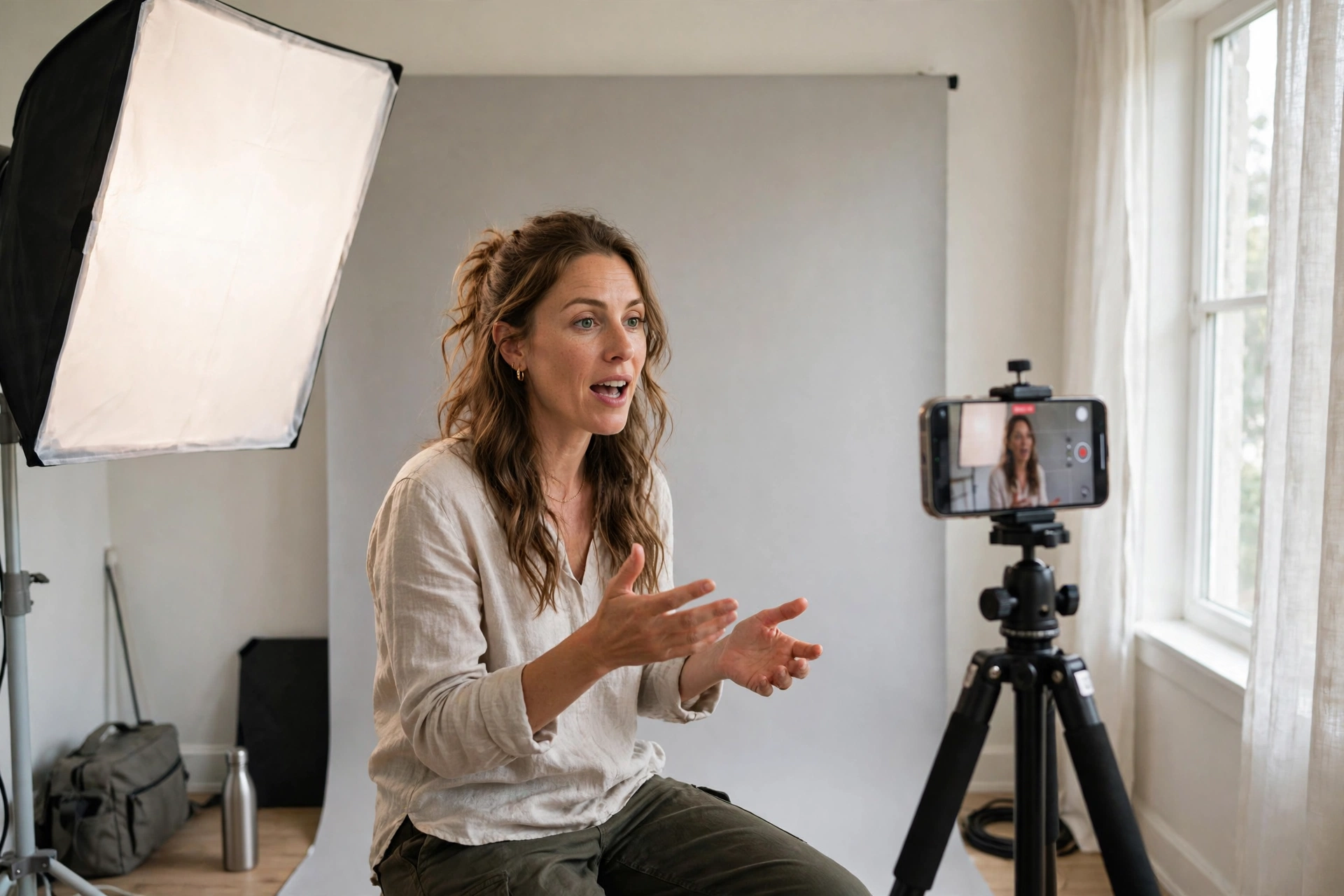
Tuesday is a filming day, and everything gets shot in one batch session. Same shirt, same light, same setup, several videos back to back. Batching is the entire trick. The setup cost of filming, lights, framing, getting into the rhythm, gets paid once instead of five times.
I film from Monday’s scripts, which means I am performing, not inventing. That distinction is worth more than any camera upgrade. Inventing on camera produces rambling. Performing a script produces pace.
Wednesday: automate (the code gear)
Wednesday is editing, scheduling, and automation. The videos get cut, captioned, and loaded into the scheduler for the week. The captions get their AI-assisted first drafts and my rewrite pass. Then the quiet work: review requests queued, report templates updated, the content calendar marked.
For one client, a brunch spot with quiet socials, I built a 45-day content plan on exactly this rhythm. The plan, not any single post, did the heavy lifting. When the system decides what goes out and when, the brand stops depending on anyone’s motivation that morning.
Thursday and Friday: engage and learn
The rest of the week the system runs itself and I do the two things no automation handles well: engaging and learning. Reply to comments. Answer DMs. Read what the numbers say about Monday’s ideas. The comments section is market research that pays you to read it, and Friday’s notes become next Monday’s scripts. The loop closes.
Repurposing Is the Whole Game
The engine’s real power is repurposing. Nothing is created twice. One idea enters the machine on Monday and exits as a week of presence across formats. Here is the map:
| Start with | It becomes | Where it lives |
|---|---|---|
| One 60-second video | Two or three short clips | Reels, Shorts, TikTok |
| The video transcript | A caption and quote graphics | Feed posts and stories |
| The core idea | A short email | Your newsletter |
| The comments it earns | Next week’s topic | Back into Monday’s scripts |
A single filming session becomes a week of output. Small teams cannot out-produce big ones, but they can out-repurpose them. Every extra format an idea lives in is distribution you did not have to create from scratch.
My Three-Format Test
Here is the quality bar I hold every content plan to. If an idea cannot live in at least three formats, it is not pulling its weight, and it does not enter the calendar.
This test kills weak ideas early, which is its real value. “Post a nice photo” fails the test: it is one format with nowhere to go. “Show the three mistakes beginners make when choosing a product” passes easily: it is a video, a carousel, an email, and a FAQ page. The test forces you to think in ideas with legs instead of posts with expiration dates.
Run your last month of content through it. Most brands discover they have been manufacturing single-use posts, which is the most expensive way to do marketing. The engine fixes that by making reuse the default, not the afterthought. Start this week: take one idea you already posted and give it two more formats. That single repurposing session will teach you more than any new tool.
What Multi-Modal Looks Like by Business Type
The engine is the same. The expression changes with the business.
Local service business
Your copy gear is Google Business posts, your website FAQ, and review responses. Your video gear is short clips answering the questions customers always ask: pricing, process, what to expect. Your code gear is automated review requests and appointment reminders. One answered question becomes a video, a FAQ entry, and a review magnet.
E-commerce brand
Your copy gear is product descriptions that actually sell and emails that people open. Your video gear is product demos, unboxings, and founder clips. Your code gear is abandoned-cart flows and post-purchase review sequences. One product story becomes a demo video, an email, and three social clips.
Personal brand or creator
Your copy gear is the newsletter. Your video gear is the short-form clips that grow the audience. Your code gear is the scheduling and repurposing pipeline between them. One strong opinion becomes a video, a newsletter issue, and a week’s worth of posts. The audience you rent on social becomes the list you own.
What to Automate First
People hear “automation” and picture something complicated. Start with the boring five. Each one takes under an hour to set up and pays back every single week:
- Scheduling. Your posts go out without you touching them that day. The scheduler is the single highest-ROI tool in the stack.
- Review requests. An automatic ask after every purchase or visit. Reviews compound. Manual asking does not scale.
- Report templates. Monthly numbers pull into a one-page template. You read the story instead of building the spreadsheet.
- Caption first drafts. AI writes the rough version, you rewrite it in your voice. The blank page is the enemy. This removes it.
- Winner recycling. Your best clips repost on a timer to catch new followers. Good content deserves a second audience.
Automate distribution and administration. Never automate the parts where judgment lives: the idea, the final edit, the reply to a real person.

Where the Engine Breaks Down
Three mistakes I see constantly. All fixable.
Mistake one: filming without a script
This is the most common and the most expensive. Filming feels productive, so people skip Monday and go straight to Tuesday. The result is hours of footage with no spine, an editing nightmare, and videos that ramble. The script is the cheapest part of production and the part everyone wants to skip. Do not skip it.
Mistake two: automating chaos
Automation multiplies whatever you feed it. Feed it a sharp weekly rhythm and you get consistency. Feed it random posting and you get random posting at scale, which is worse, because now the mess runs itself. Get the loop working manually for two weeks before you automate any of it. The engine earns its gears in order: copy, then video, then code.
Mistake three: creating for every platform
Beginners hear “multi-modal” and start making unique content for six platforms. That is not the engine. That is six jobs. The engine is one idea expressed in the formats each platform rewards, through repurposing. Create once, adapt deliberately. If a platform needs something that cannot be repurposed from your core idea, question whether you need that platform at all.
Frequently Asked Questions
Do I need to be on camera for this to work?
It helps, but it is not required. Faceless formats work well: screen recordings, product close-ups, text-on-screen videos with voiceover. What the engine requires is a recognizable voice and consistent presence, not your face. That said, if you can be on camera, do it. Familiarity converts, and faces build familiarity fastest.
What tools do I actually need to start?
Fewer than you think. A phone made in the last three years, an inexpensive tripod, free editing software like CapCut, and a scheduler with a free tier. The engine is a workflow, not a shopping list. I have watched brands with cinema cameras and no system lose to phones with a rhythm. Buy the tripod. Build the rhythm.
How much time does the weekly rhythm take?
For one brand, roughly a focused day spread across the week once the rhythm is set: a writing block Monday, a filming block Tuesday, an editing and scheduling block Wednesday. The first two weeks run slower while you build templates. After that the system carries the load, and adding a second brand costs far less than the first one did.
Can one person really run all three gears?
Yes, and that is the point. The engine exists so one person, or a very small team, can produce like a bigger one. The gears are sequential, not simultaneous: you are never writing, filming, and automating at the same time. Each gear has its day. If you are drowning, you do not need more people. You need the loop.
Should I hire someone to build this engine for me?
If the bottleneck is time or taste rather than knowledge, yes. Some brands need the system installed and running, not another tutorial. That is a service I offer: the engine built for your brand, in your voice, on a schedule your team can keep. Check the pricing page for current packages, or get in touch and tell me what you are working with.
How do I know the engine is working?
Watch what compounds, not what spikes. Saves and shares per post, email replies, DMs that start conversations, comments from the same names week after week. A viral video that brings followers who never engage is a sugar rush. A quiet week where three past customers mention your content is the engine compounding. Give it ninety days of consistent rhythm before you judge it. Systems do not sprint, they accumulate.
The Bottom Line
Stop thinking in posts. Start thinking in ideas, and give every good idea three formats to live in. Write it Monday, film it Tuesday, automate it Wednesday, learn from it Friday. That is the whole engine. It is not glamorous, which is exactly why most of your competitors will never build it.
If you want this engine built for your brand instead of built by you, get in touch. And if this helped, send it to one business owner still creating every post from scratch.