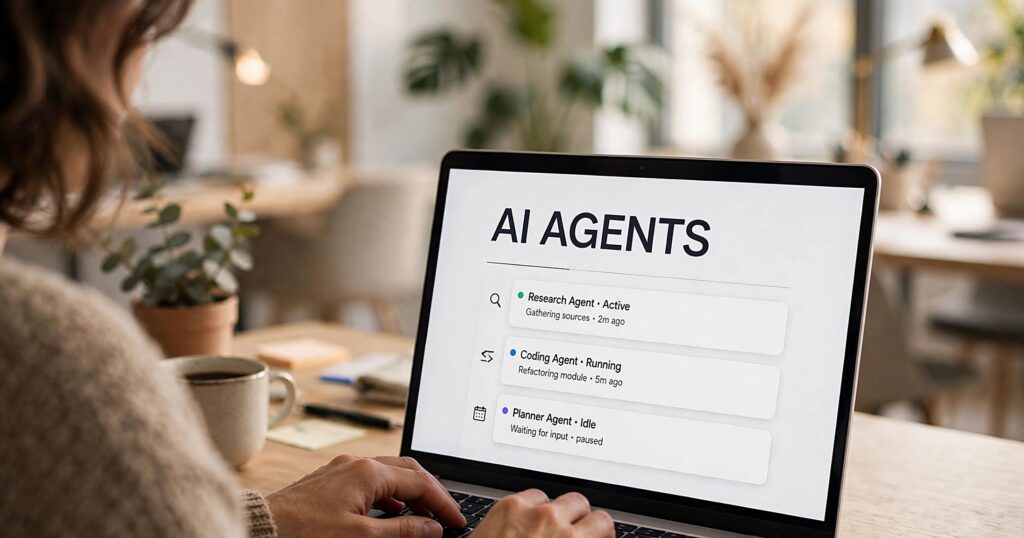
Everyone is talking about AI agents. Almost no one agrees on what the term means. I have watched clients buy expensive “agent” platforms that turned out to be chatbots with better marketing, and I have watched others dismiss agents entirely because they assumed it was hype. Both mistakes cost real money. This guide clears it up: what AI agents actually are, how they differ from chatbots, copilots, and automation, the five types you should know, and where the technology honestly stands today.
What Is an AI Agent, Really?
An AI agent is a software system that can perceive its environment, make decisions, and take actions to achieve a goal with minimal human intervention. That is the textbook definition. Here is the practical one: an AI agent is the difference between a tool that answers your questions and a tool that does your work.
Four capabilities separate a true agent from everything else carrying the label:
Perception. It takes in information from its surroundings. That could be your emails, a spreadsheet, a website, or sensor data. It does not wait for you to hand it everything on a plate.
Reasoning. It thinks through a problem, breaks it into steps, and decides what to do next. If step three fails, it does not freeze. It tries a different approach.
Action. It uses tools to get things done. It can browse the web, send emails, update your CRM, run code, or book appointments. This is the part most “AI” products skip.
Learning. It gets better from experience. It remembers what worked, what did not, and adjusts.
I like to explain it with a simple comparison. A chatbot is a vending machine: you put in a request, you get a response. An AI agent is a personal assistant: you describe the outcome you want, and it figures out the steps, handles the obstacles, and reports back when it is done.
AI Agent vs Chatbot: The Difference Everyone Gets Wrong
This is the confusion I see most often, and it is not the buyers’ fault. Half the products marketed as “AI agents” today are chatbots wearing a costume. Here is how to tell them apart:

| AI Chatbot | AI Agent | |
|---|---|---|
| Waits for your message | Yes, always | No, can act on its own |
| Handles multi-step tasks | No, one question at a time | Yes, plans and executes sequences |
| Uses external tools | Rarely, and only if built in | Yes, browsers, APIs, apps, files |
| Adapts when something goes wrong | No, gives up or loops | Yes, tries another approach |
| Remembers across sessions | Usually not | Often, and learns from outcomes |
| Real example | Answers “what are your hours?” | Notices you are low on stock, finds suppliers, compares prices, places the order |
The test I give clients is simple. Ask the tool to do something that takes five steps. If it does step one and waits for you, it is a chatbot. If it does all five and tells you when it is finished, it is an agent.
When do you actually need each one? A chatbot is enough when people just need quick answers: store hours, pricing, order status. You need an agent when the task itself is the work: researching suppliers, qualifying leads, managing a calendar, reconciling invoices. Most small businesses I work with need both, for different jobs.
AI Agent vs Copilot: Not the Same Thing
“Copilot” is Microsoft’s brand, but the concept is everywhere now: GitHub Copilot, various writing copilots, design copilots. A copilot sits beside you while you work and suggests the next step. You stay in the driver’s seat.
An agent takes the wheel. You describe the destination, and it drives.
The practical test: can it finish the task if you walk away? A copilot cannot. It needs you there, approving, editing, steering. An agent can, at least for well-defined tasks. That is the entire difference, and it determines which one fits your workflow.
In my experience, copilots are better for creative and judgment-heavy work where you want to stay in control: writing, design, code review. Agents are better for operational work where the process is clear but time-consuming: data entry, follow-ups, monitoring, scheduling. They are complements, not competitors.
AI Agent vs Traditional Automation: Rules vs Reasoning
If you have used Zapier, Make, or even a simple email filter, you have used traditional automation. It follows fixed rules: when this happens, do that. When a new order arrives, send a confirmation email. When a form is submitted, add a row to the spreadsheet.
This works beautifully until reality deviates from the script. The supplier changes their invoice format. The customer writes something unexpected. The website updates its layout. Traditional automation breaks, silently or loudly, and someone has to fix it.
An AI agent does not follow a script. It pursues a goal. Tell it “keep our inventory updated” and it figures out the steps: check the supplier portal, read the invoice (whatever format it arrives in), update the spreadsheet, flag anything unusual. When the format changes, it adapts instead of breaking.
| Traditional Automation | AI Agent | |
|---|---|---|
| How it works | Fixed if-then rules | Goal-directed reasoning |
| Handles surprises | No, breaks or skips | Yes, adapts its approach |
| Setup effort | High, every edge case mapped | Lower, describe the goal |
| Best for | Stable, repetitive processes | Messy, variable real-world tasks |
| Example | “When payment received, send receipt” | “Chase every overdue invoice until paid” |
Here is my honest take after setting up both for clients: automation is cheaper and more reliable for processes that never change. Agents earn their keep the moment your process involves judgment calls, messy inputs, or exceptions. Most growing businesses eventually need both.
The 5 Types of AI Agents, From Simplest to Most Advanced
Not all agents are equal. Researchers classify them into five types, and understanding the ladder helps you judge what any product can actually do:

1. Simple reflex agents. They react to the current input with a fixed response. A thermostat is the classic example: too cold, turn on the heat. No memory, no planning. Most “smart” features in apps are this level.
2. Model-based agents. They keep an internal picture of the world. A robot vacuum that maps your house is model-based: it remembers where it has been and plans where to go next. More useful, still limited.
3. Goal-based agents. They work toward an objective and plan the steps to get there. A chess program is goal-based: it considers future moves, not just the current board. This is where things start feeling intelligent.
4. Utility-based agents. They do not just reach the goal, they find the best way there. They weigh trade-offs: fastest route vs cheapest route vs most reliable route. A travel-booking agent that balances price, timing, and your preferences is utility-based.
5. Learning agents. They improve from experience. Every task teaches them something, and they perform better next time. The AI agents making headlines today, the ones from OpenAI, Anthropic, and Google that can browse, code, and operate software, are learning agents. This is the type most “AI agent” products claim to be, and the fewest actually are.
When a vendor pitches you an “AI agent,” ask which type it is. If they cannot answer clearly, you have your answer about the product.
Where We Stand: The Honest Picture
The hype says agents will run entire businesses autonomously. The reality is more useful and less dramatic.
What genuinely works today: Customer service agents that resolve most inquiries without escalation. Coding agents that write, test, and debug real software. Research agents that gather and synthesize information from dozens of sources in minutes. Scheduling and inbox agents that handle the administrative load most founders drown in. I have deployed versions of all of these for clients, and they deliver.

What is still mostly hype: The fully autonomous business. Agents that negotiate, make strategic decisions, or handle genuinely novel situations without oversight. The technology is improving fast, but judgment, taste, and accountability still belong to humans.
The reality everyone lives in: human in the loop. The best setups today let agents do the work and humans approve the outcomes. The agent drafts, the human reviews. The agent flags, the human decides. This is not a limitation to overcome, it is the correct design. You want speed from the machine and judgment from the person.
My prediction, based on watching this space closely: in the near future, the question will not be “should we use AI agents” but “which of our processes still need a human doing them manually.” The winners will be businesses that answer that question deliberately instead of waiting.
What This Means for Your Business
Here is the good news: you do not need to memorize the five types or understand the architecture. You need to answer one question: what repetitive work is eating your team’s time every week?
List it. Then ask whether each item needs judgment or just effort. The “just effort” pile is where agents pay for themselves fastest: follow-ups, data entry, scheduling, monitoring, first-draft anything.
If you want the practical next step, I wrote a hands-on guide to actually setting these up: AI Agents for Small Business. It covers the five no-code ways to get an agent working this week, what they cost, and the limitations to know before you connect anything.
And if you would rather have someone set it up properly than figure it out yourself, that is literally what I do. Tell me about your bottleneck and I will give you an honest answer about whether an agent fits.
Frequently Asked Questions
What is the main difference between an AI agent and ChatGPT?
ChatGPT is a conversational AI: you prompt it, it responds. An AI agent goes further. It can plan multi-step tasks, use external tools like browsers and apps, and complete work independently without you guiding each step. Think of ChatGPT as a brilliant advisor and an AI agent as an employee who does the job and reports back.
Are AI agents the same as bots?
No, traditional bots follow fixed scripts and break when something unexpected happens. AI agents reason about the situation, adapt their approach, and make decisions based on changing conditions. A bot is a recording; an agent is a problem solver.
Do I need coding skills to use AI agents?
No, the leading agent platforms today are no-code: you describe what you want in plain language and the agent figures out the execution. Technical knowledge helps you evaluate vendors, but it is not required to get value from the tools.
What is the difference between single-agent and multi-agent systems?
A single agent handles tasks on its own. A multi-agent system uses several specialized agents working together, like a team: one researches, one writes, one reviews. Multi-agent setups handle more complex workflows but need more careful design to avoid the agents working at cross purposes.
Are AI agents safe for business data?
They can be, with the right setup. Limit each agent’s permissions to exactly what it needs, require human approval for irreversible actions like payments or deletions, and never connect an agent to systems containing sensitive data without understanding where that data flows. Start narrow and expand access as trust builds.
Will AI agents replace employees?
They replace tasks, not people. The businesses seeing real results use agents for repetitive operational work so their team can focus on relationships, creativity, and judgment, the things agents cannot do. If anything, agents make good employees more valuable by removing their busywork.
The Bottom Line
The field is moving fast, but the fundamentals are simple. A chatbot answers. A copilot assists. Automation follows rules. An agent pursues goals. Once you see the distinctions, the marketing noise fades and the real question appears: which of your repetitive tasks deserves an agent?
Start there. The technology is ready. The only thing it cannot do is decide for you what matters.