


Every journalist, writer, and researcher I talk to is asking the same question right now: is AI here to help me, or replace me? After months of watching how newsrooms actually use these tools, and where they keep failing, I have an answer. AI is not coming for the journalist. It is coming for the drudgery. What remains, the judgment, the trust, the ethics, the presence, is more valuable than ever. This is a practical guide to where AI genuinely helps, where it has already failed, and where your human edge lives.
What Journalists Actually Hand to AI
Let’s start with what is really happening inside newsrooms, because the reality is calmer than the headlines suggest.
A 2026 survey of 803 Australian journalists by Medianet found that 54% now use generative AI tools, up from 37% two years earlier. But here is the important part: they are not using AI to write publishable articles. They use it to summarize documents (50%), transcribe interviews (46%), do background research (45%), and proofread (39%). The most used tools are ChatGPT and Gemini. A global 2026 study by FT Strategies and WAN-IFRA across 86 countries found the same pattern: transcription and translation is the most common AI use in newsrooms, at 78%.
The pattern is consistent. Journalists delegate the mechanical work to AI and keep the journalism for themselves. Transcription tools like Otter.ai, Trint, Descript, and Rev turn hours of interview audio into searchable text. Research tools like Perplexity and Google’s NotebookLM help sift through background material. Document analysis tools like Google Pinpoint and DocumentCloud help reporters search thousands of pages. None of these tools write the story. They clear the desk so the reporter can.
This is the task split that matters, and it is worth remembering: transcription, summarization, research, and proofreading are what journalists delegate. Judgment, verification, and storytelling are what they keep.
What the Major Newsrooms Allow, and Where They Draw the Line
Every serious newsroom has now written AI rules, and they all converge on the same principles. The Associated Press updated its guidelines in 2026 to allow AI for research, transcription, summarization, and headline help, but states clearly that AI cannot replace original reporting, source verification, fact-checking, or editorial judgment. The BBC requires that no AI-assisted story is published until a journalist reviews and approves it, and labels AI-assisted content so readers know. The Guardian permits only limited uses, like transcribing audio or analyzing parliamentary documents, and only with a senior editor’s permission. Reuters requires journalists to verify any AI-generated claim before publication.
Three rules appear everywhere: a human reviews everything before publication, generative AI must not create or alter news photography, and a human stays accountable for what gets published. The Financial Times goes further, with a default position that generative AI must not be used to write article text for publication at all.
Notice what this means. The most trusted news organizations in the world looked at AI and decided the same thing: it is a tool for the workflow, never a replacement for the journalist. That consensus is worth more than any single opinion, including mine.
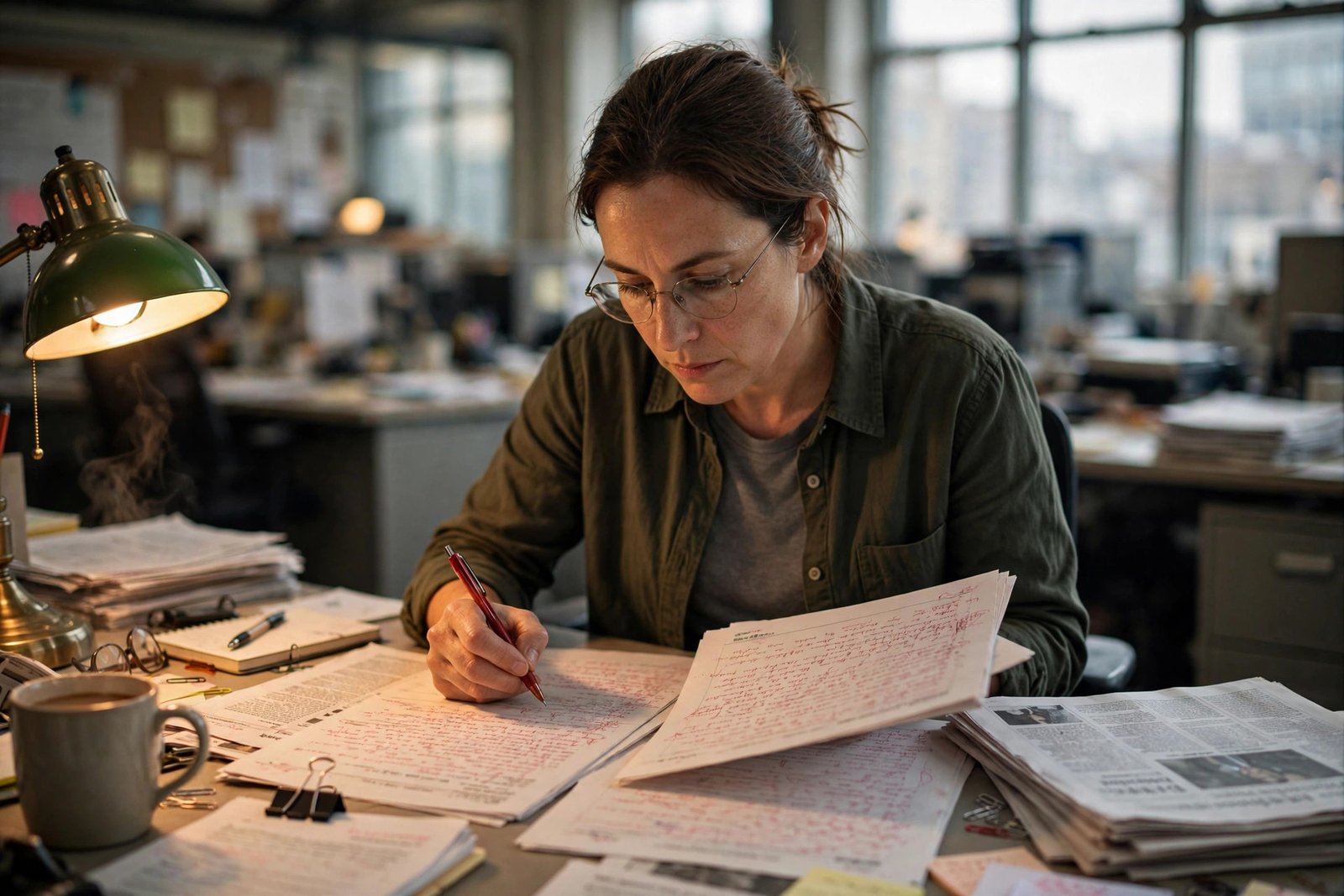
Where AI Has Already Failed in Journalism
The failures are instructive because they follow the same patterns again and again. Press Gazette maintains a live tracker of AI mistakes in journalism, and the cases tell a consistent story.
In 2026 alone: Canadian outlets published opinion pieces by “Daniel Robson” more than twenty times before discovering he does not appear to be a real person. A supposed art therapist named “Dr Eleni Nicolaou” was quoted as an expert more than thirty times across major publications before her credentials fell apart. A story appeared under a Cleveland reporter’s byline while she was on her honeymoon, published by an “Express Desk” that uses AI tools. The New York Times ended its relationship with a freelance book reviewer after discovering his AI-assisted draft had folded in plagiarized material from another publication’s review.
The earlier cases follow the same script. A Wyoming reporter resigned in 2024 after admitting he used AI to generate article text with entirely fabricated quotes. A Belgian broadcaster exposed fake psychologist bylines across dozens of magazine articles. A former media CEO published hallucinated quotes in his own newsletter after using AI to summarize reports.
The failure pattern is stable across years: hallucinated quotes, fake bylines, fake experts, and undisclosed AI drafting. Every one of these failures happened at exactly the point where a human stopped checking. The lesson is not that AI is useless. The lesson is that AI without a journalist in the loop is a liability machine.
What AI Cannot Do
This is the heart of it. After reading newsroom policies, failure reports, and statements from working editors, the same list keeps appearing. Here is what AI cannot do, and why each item is your edge.
1. Earn a source’s trust
No source has ever confided in a chatbot. Trust is built over years: showing up, getting the story right, protecting people who talk to you, calling back when you said you would. A Singapore minister put it plainly at a press event: no algorithm can substitute for the years spent understanding a beat, building sources, and learning how an industry actually works. A reporter who has covered the local healthcare system for a decade asks a different question than one relying on a search engine. Sources talk to people they trust. That trust is not transferable to software.
2. Exercise news judgment
Deciding what is newsworthy, what is fair, what is true, what is contextual, and what is meaningful, these are judgments, not computations. An AI can summarize a thousand documents, but it cannot tell you which of the thousand matters most to your readers, or why. The former CNN deputy managing editor Jim LeMay has warned newsrooms directly: if you eliminate people and just have AI crank content out, you may lose the reason you exist, which is people’s trust in you. He draws the line at creative and critical thinking, at judgment.
3. Make ethical calls
Should you name the victim? Should you publish the allegation before the response arrives? Does the public interest outweigh the harm? These decisions have no correct answer that a model can compute. They require a human being to weigh competing values and take responsibility for the choice. Arab News deliberately keeps AI away from what its editor calls journalism’s core functions, using it for translation and research while journalists retain reporting, verification, and editorial judgment.
4. Verify what actually happened
AI predicts plausible text. Journalism establishes what happened. Those are opposite operations. The BBC ran a study with the European Broadcasting Union and found that AI assistants misrepresented news content, through faulty sourcing, fabricated details, or outdated information, 45% of the time. The BBC published those findings instead of burying them. Verification is the job AI is worst at and journalists are most needed for. As the WAN-IFRA chief executive Stig Orskov has argued, algorithms cannot replicate the rigorous verification process and professional editorial judgment of independent news publications.
5. Be present
AI was not in the courtroom. It did not stand in the rain outside the hospital. It did not notice the official’s hesitation before answering, or the document left on the photocopier. Reporting is a physical act of witnessing, and presence produces the details that make stories true and alive. LeMay makes this point sharply: the models are not out in our communities, not reporting from where people live.
6. Take accountability
When a story is wrong, a human being answers for it. Corrections carry a name. Lawsuits name defendants. Readers trust publications because real people stand behind the words. Ellana Lee of CNN International has stated the network’s position clearly: a human journalist will always look at the final product before it goes out. Accountability cannot be delegated to a system that cannot be fired, sued, or ashamed.

The Honest Picture on Jobs
I want to be straight with you here, because the jobs question deserves honesty, not comfort.
The evidence so far is genuinely mixed. A 2026 Reuters Institute survey of digital news leaders found that 67% of publishers had cut no jobs due to AI, while 16% reported small cuts. At the same time, the Medianet survey found that 22% of Australian journalists had lost work or knew someone who had in 2025 because of generative AI, up from 16% the year before. Freelancers, casual workers, and production roles like copy editing are the documented pressure points. And 43% of global newsroom leaders expect AI to cut staff numbers within the next three years.
Here is how I read that tension: the fear of future cuts currently runs ahead of realized cuts, but the pressure on freelancers and production staff is real and documented. The journalists most at risk are the ones doing the most automatable work. The defense is not to avoid AI. It is to move up the value chain toward the things on the list above, the judgment, the sources, the verification, the accountability, which no model can do.
Where AI Genuinely Helps Investigations
There is one area where AI has a proven, documented record of making journalism better: investigations. And the pattern here is instructive, because AI never works alone.
The International Consortium of Investigative Journalists has the deepest track record. For the Implant Files investigation, reporters trained a machine learning algorithm to find death reports misclassified as injuries, then human fact-checkers manually reviewed every one of the 2,100 cases the algorithm surfaced. For the Panama Papers follow-up work, ICIJ collaborated with Stanford researchers to apply machine learning to leak-scale document troves. The Atlanta Journal-Constitution used machine learning to score more than 100,000 physician disciplinary documents, then reporters read every document behind the thousands of cases found. Ukrainian outlet Texty analyzed 450,000 satellite images with machine learning to uncover illegal amber mining.
The ICIJ’s deputy director Marina Walker Guevara states the principle directly: the computer is augmenting the work of a journalist, not replacing it. Her colleague Emilia Diaz-Struck adds: the bottom line is that they use it to solve journalistic problems that otherwise would not get solved. The methodology even has a name among investigators: reporter in the loop. Domain experts train the models, and humans review every algorithmic finding.
This is the model for everything else. AI finds the pattern. The journalist decides what it means, verifies it, and stands behind it.

Your Monday Morning Workflow
Theory is useful. Here is what all of this looks like on a real working day.
Morning: research with AI as your assistant. You have an interview at noon. Feed your background documents into a research tool like NotebookLM or Perplexity and ask for a briefing: key facts, disputed claims, questions worth asking. Then read the output against the originals, every word. The AI gives you speed. You keep the judgment about what matters.
Midday: record everything, transcribe with AI. Record your interview (with permission, always). Run the audio through Otter.ai, Trint, or Descript and you have searchable text instead of two hours of scrubbing. Pull your quotes from the transcript, but verify each one against the recording. AI transcription is very good and occasionally wrong at exactly the worst moment.
Afternoon: draft with AI nowhere near the pen. Write your first draft yourself, from your notes and your judgment. Bring AI in after the draft exists: for proofreading, for headline options, for checking whether your structure buries the lead. Never the other way around. Every newsroom policy above says the same thing, and every failure case shows what happens when you reverse the order.
Before filing: verify like your byline depends on it. Because it does. Every fact AI touched gets checked against a primary source. Every quote gets verified against the recording. This is the step the failed outlets skipped, every single time, and it is the step that makes you a journalist instead of a content forwarder.
Your Edge: A Practical Playbook
So what do you actually do with all of this? Here is the playbook I would hand to any journalist, writer, or researcher starting today.
Delegate the mechanical, own the judgmental. Use AI freely for transcription, summarization, first-pass research, and proofreading. These are the tasks the surveys show working journalists already delegate. Never let it make a claim, a quote, or a judgment call without your verification.
Build the assets AI cannot replicate. Your source network, your beat expertise, your reputation for accuracy, your physical presence in a community. Every hour invested here compounds. These are the moat.
Learn the tools, but as an editor of their output. The journalists thriving right now are not the ones avoiding AI or the ones publishing its raw output. They are the ones who treat AI like a fast, confident, occasionally lying research assistant: useful, never trusted.
Specialize in verification. As AI-generated content floods the information environment, the ability to establish what actually happened becomes more valuable, not less. Verification is the growth industry inside journalism.
Put your name on your work. In a media environment filling with fake bylines and synthetic experts, a real name attached to real accountability is a competitive advantage. Be the journalist readers can find, question, and trust.
Frequently Asked Questions
Will AI replace journalists?
The evidence says AI is replacing journalistic tasks, not journalists. Surveys show working reporters use AI mainly for transcription, summarization, research, and proofreading, while keeping judgment, verification, and source relationships for themselves. Every major newsroom policy requires human review before publication. The roles under real pressure are freelancers and production staff doing the most automatable work.
What AI tools do journalists actually use?
The most common uses are transcription (Otter.ai, Trint, Descript, Rev), research (Perplexity, NotebookLM, ChatGPT), document analysis (Google Pinpoint, DocumentCloud), and proofreading. Newsrooms have also built their own tools, like Reuters’ Fact Genie and the BBC’s Style Assist. The consistent pattern is AI as a workflow assistant, not a writer.
Can I use AI to write my articles?
Every major newsroom policy says no, or not without heavy guardrails. The Financial Times bars generative AI from article text by default. The AP requires all AI output to be reviewed and edited by a journalist. The documented failures, hallucinated quotes, fake bylines, plagiarized passages, all happened where AI-generated text went out with too little human checking. Use AI to help you write; do not let it write for you.
What can AI never do in journalism?
Build source relationships, exercise news judgment, make ethical calls, verify what actually happened, be physically present where news happens, and take accountability for published work. These are the consensus items across newsroom policies and editors’ statements, and they form the durable human edge.
How should freelance writers position themselves as AI spreads?
Move toward the work AI cannot do: original reporting, source development, beat expertise, verification, and accountability. Specialize rather than generalize. Put your real name on real work. The freelancers most affected so far are those doing easily automatable production tasks; the defense is to become the person clients trust with judgment, not just output.
Is AI useful for investigative journalism?
Yes, with the reporter in the loop. Documented successes include the ICIJ’s Implant Files, the Atlanta Journal-Constitution’s physician misconduct series, and BuzzFeed News’ spy planes investigation. In each case, AI found patterns across massive datasets and human journalists verified every finding. AI finds; the journalist decides.
Want help making your work impossible to ignore?
I help writers, founders, and brands turn expertise into content people trust and share. If you are building something worth reading, let’s talk.